Fate or Chance?
In the spring of 2000, I arrived at the entrance examinations for the painting programme at the University of Pécs’s Faculty of Music and Visual Arts, entirely unsuspecting and innocent. Among the enormous canvases and artistic affectations of seasoned applicants returning for another attempt, I felt rather unremarkable. The influences I had embraced with such fervour were readily apparent in the portfolio I had assembled within the nurturing cocoon of the secondary art school in Zirc: it was full of homage pieces. Ilona was the magnetic centre of the large, predominantly male admissions panel. It was the first time I had seen her, and, though I take no pride in admitting it, I was not yet particularly familiar with her work either. At secondary school, my touchstones had been the Hungarian Eight and the Activists, so the painters I named as my chosen masters during the interview were rather anachronistic choices. Fortunately, Ilona Keserü also loved the past, and her generation formed a bridge between those painters and me. At the time, almost every applicant named László Fehér—whom I also admired—as their favourite, while my list began with Kmetty, Ziffer and Perlrott-Csaba. Ilona must have liked my long list of names, because, as I discovered a little later in her figurative paintings, the spectral colours muted into earth tones and the blocky brushwork of the Hungarian Cubo-Expressionists were also part of her painterly vocabulary: a tradition she could call upon.
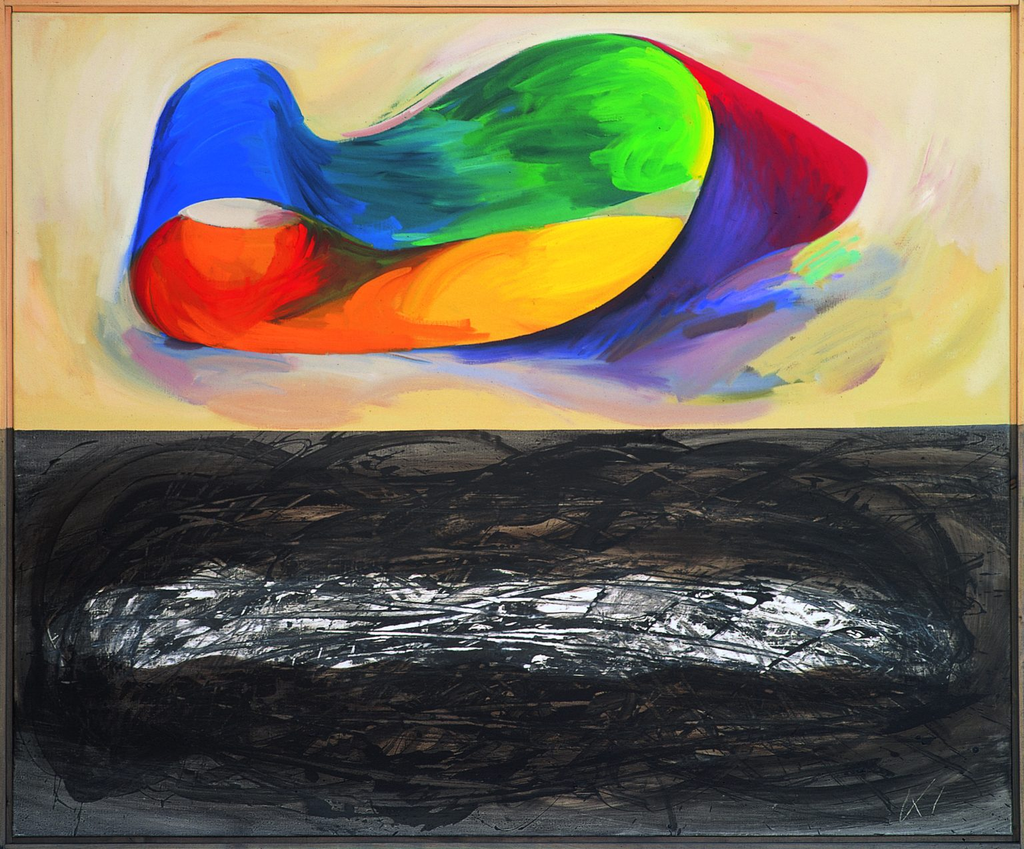
Ilona Keserü: Velázquez’s Tomb I, 1998. Oil and enamel on canvas, 140 × 170 cm.
My ignorance of her was quite genuine. From the panel’s perspective, however, it might well have looked as though I had carefully studied her interests to improve my chances of admission. I had brought several dozen drawings and two oil portraits of Géza Ottlik. Only later did I learn how close a friendship Ilona and Ottlik had shared. When she asked why I painted Ottlik, and whether I had read anything by him, I confidently replied that I had read nothing: I simply liked his face. What was more, I had used precisely the palette that the Nagybánya Neoists had fashioned by combining the earth tones of the Hungarian Barbizon tradition with the unrestrained palette of the French Fauves. I had painted in these heated colours throughout secondary school, yet my first introduction to them had come neither from one group nor the other, but from László Bencze’s Expressionist paintings of the 1940s. Bencze belonged to the generation after the Eight, and in the 1930s he had lived in Dudar, the village where I was born. Stories about him and a few of his murals still exerted an influence there, and as a child I knew of no other painter, even from books. From the age of six, I copied painting after painting from a short monograph he had inscribed to my parents, although my enthusiasm for him found little response among those around me. Naturally, it was only later that I also discovered that Bencze had been Ilona’s teacher at the Hungarian College of Fine Arts between 1952 and 1955, and that she had loved precisely the paintings I had copied as a child. She later recalled him in these words:
“I think of László Bencze’s work at the time, which we liked very much. There, in front of the paintings, my colleagues, my friends and I decided that the best thing would be to get into László Bencze’s class at the College. His peasant-woman paintings were on display too, those very painterly pictures he had painted in Dudar not long before. He painted in a style that was a little reminiscent of Van Gogh. He used colour, and there was a particular tone to his work…”
During her years at the College, Ilona became Bencze’s favourite student. According to the minutes of the staff meetings routinely held in the 1950s, he always defended her against accusations that the young woman was failing to undertake community work.
Having ultimately passed the entrance examinations, I thus gained in Ilona not only a great master, but someone who understood the childhood I had spent painting: a means of connecting with the past, and someone who affirmed that connection.
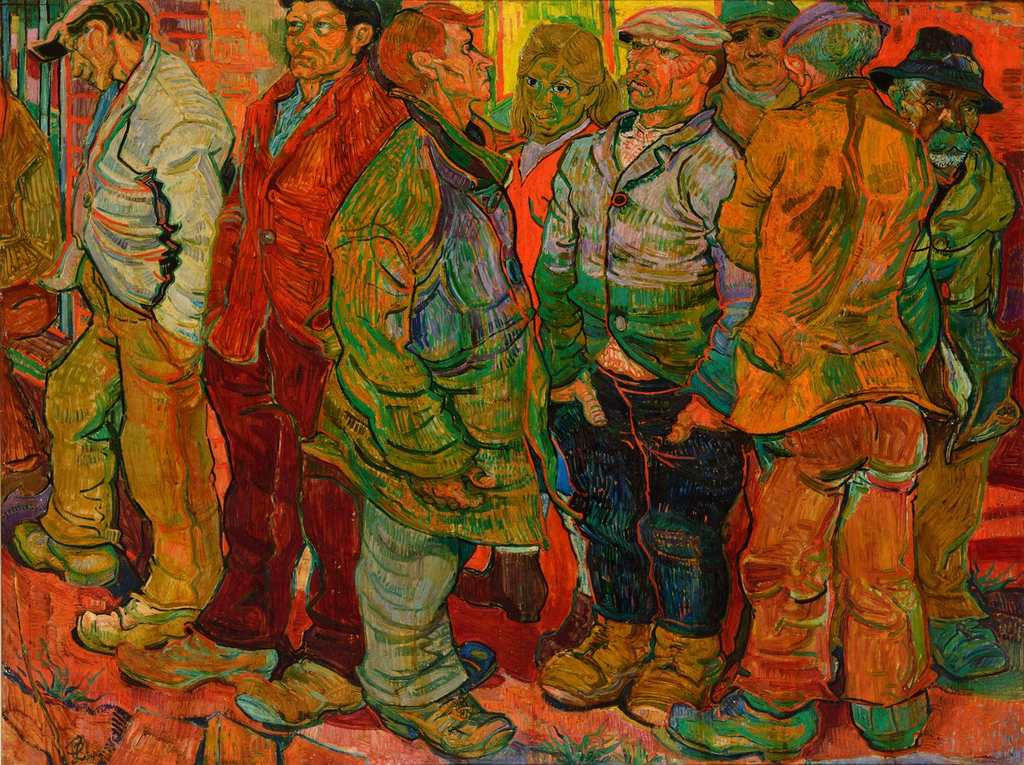
László Bencze: The Unemployed, 1944. Oil on panel, 125 × 167 cm.
The “Little Keserüs”
Ilona had been teaching in Pécs since 1983, but after 1990 she worked exclusively with students in the master school and postgraduate programmes. In the year I entered university—or so we were told—she wanted, after a long interval, to work with the “little ones” again and teach foundation painting, perhaps partly out of nostalgia for Bencze’s class. After the entrance examinations, a few fortunate fellow students and I were assigned to her, and instead of the main building, we were given a studio in the building used by doctoral students. This separate path earned us a certain respect, not only among our own year group but among the older students too. We became the “little Keserüs”.
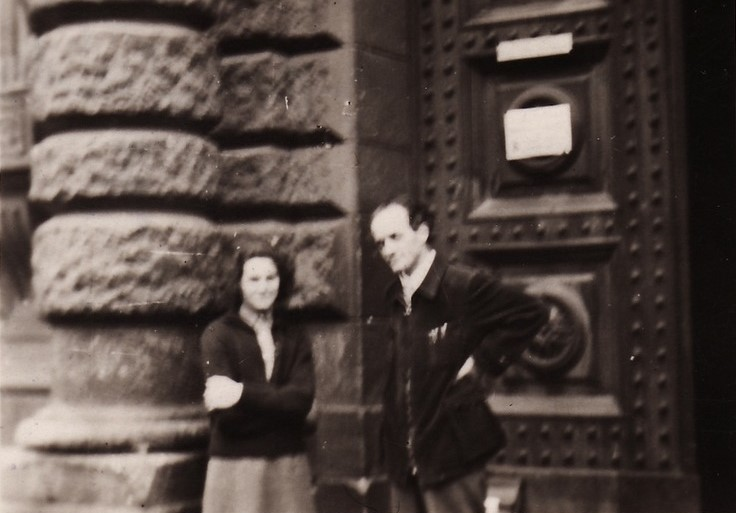
Ilona Keserü and László Bencze outside the Hungarian College of Fine Arts, 1952.
During the first weeks of the course, we were still showing and discussing the earlier work we had brought with us. Then it became noticeable that hardly any new work was being produced: everyone had managed only a few small sketches. The usual paralysis that comes with a new situation was only part of the reason. In fact, most of us had exhausted our money getting ourselves established at university and could barely afford art materials. Somehow Ilona got this out of us, then gathered up her students and took us around Pécs on local buses, visiting several household shops and an art supply shop. At her own expense, she bought materials for us to form a shared stock. She also gave us an enormous roll of hemp canvas from her studio. From then on, we knew there were no more excuses: we had to work.
Ilona came to see us twice a week from her studio flat in Mogyorós köz, a few stops from the Faculty. On some days, our consultations began at ten in the morning and continued until four in the afternoon without any of us getting up from beside the paintings. We did not even go to the toilet, and although our stomachs were rumbling, nobody moved until the critique was finished. We could see that Ilona was giving everything she had, and we also knew that she would not repeat what she told us. What mattered was not only what she said, but how she said it. As she chose her words, seventy years of experience and lessons seemed to stir behind them. She could spend a very long time looking at our paintings. She asked about technique, process and intention. She remembered works of ours that she considered more successful from several years earlier, and would return to them from time to time.
Master and Mentor
I see Ilona Keserü’s value as a teacher not only in her own qualities, but also in relation to the people and the prevailing attitudes around her, from which she stood distinctly apart. What she did not do or say was just as important. Unlike many others, for example, she did not keep telling us to find our own style. Nor did she insist that one painting should resemble the next. She did not demand the kind of up-to-dateness that was already being parroted endlessly then, as it still is. This may seem surprising, since Ilona had explored every corner of the artistic canon and maintained a constant public presence in the art world. I do not suppose she wanted to spare us that world. Rather, she regarded youth and the years of study as a privileged period that could be burdened by the desire to arrive at a settled artistic identity too soon. She spoke of copying and becoming conscious of one’s influences as important stages in an artist’s development, and described painters as maturing later than practitioners of other art forms. She valued experimental curiosity, seeing it as part of a natural process of exploration. For that very reason, she did not demand an intellectual justification for every painting, though she liked us to talk about our work.
As a first-year student, I once returned from a weekend at a museum having discovered a portrait by Jenő Gyárfás, a painter who had faded into the ranks of the Munich Realists. Her response was: “There’s a sex appeal to Gyárfás’s brushwork.” Of Benczúr’s draperies, she said: “They make your mouth water.” She likened Jackson Pollock’s painting to the scattering of ingredients when making strudel.
She placed music above painting. She did not invoke “contemporaneity”, nor did she treat contemporary artists as a separate caste or one destined to save the world. She had none of the chronological snobbery that assumes today’s work is better than yesterday’s. Instead, she emphasised the continuity of painting, measuring art against the great masters and those of earlier times. She was entirely independent of the familiar clichés of art history. Within painting’s sprawling family tree, Velázquez was as much a living presence for her as Dezső Korniss or István Nádler. She also held many lesser-known painters in high regard. It was from her that I first heard of Béla Vidovszky’s interiors, but she would also bring up the unfashionable Mácsai or Győző Somogyi’s paintings if the conversation turned that way.
She respected pictures in general, even those she did not consider art. Regardless of their artistic quality, she could love works for their emotional and human significance, and for the imprint of their time. It was also from her that I first heard the distinction she made about her own portraits: for her, a portrait was not an artistic product, but a magical means of taking possession of its subject. She painted Tandori, Ottlik and Ilona Ormos out of personal attachment, rather than as contributions to her oeuvre.
Gestures, Near and Far
I was formally Ilona’s student from 2000 to 2003, when she turned seventy, but our connection continued afterwards like an underground stream, surfacing from time to time. At her personal invitation, I attended the 2007 Colour Power course, which had been organised for the doctoral students of the time. I managed to get away from the Bakony region for a week, with a great deal of painting left undone. There were materials, canvas and space in abundance, and I threw myself into several large paintings at once. Those days made up for months. Ilona dropped in now and then; we were pleased to see one another, but no substantial conversation developed between us. Many of us were working together, with ample space between us, in an enormous hangar at the Zsolnay factory, so she could look at the paintings in progress even when their makers were not necessarily there. Then, on the last morning, my phone rang. It was Ilona. She said there were things of real value in one of my paintings, but that some passages remained unresolved. Over the phone, she described in detail which gestures and colours she found problematic in the six-square-metre canvas. For almost half an hour, we discussed brush sizes and initiating gestures from the shoulder. She had recognised the painting’s strengths and wanted to save it.
A few years after graduating, I was already well into teaching in Zirc. I had a family and a mortgage. There was little time to paint, and I felt professionally isolated as well. Taking advantage of a school trip to Pécs with the class I was responsible for, I visited her studio for an hour. In response to her questions, I began explaining the complications of my situation. She said: “Don’t worry, painting is under your skin!” Then, before I left, she opened a drawer full of paints and told me to choose whichever tubes of oil colour I liked. I felt awkward, but I did not resist the encouragement. I chose some good colours. I still paint with some of them.
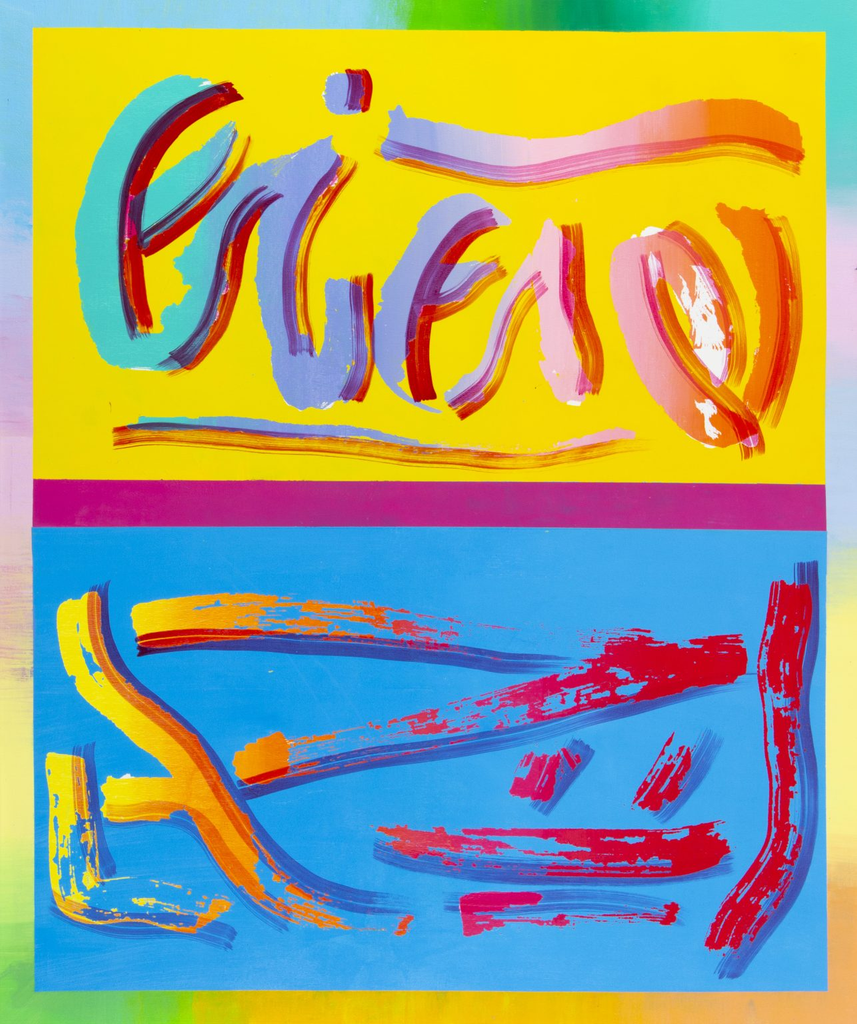
Barnabás Földesi: Equinox, 2024. Acrylic on canvas, 120 × 100 cm.